Generating a Sales Order
Generating a Sales Order
Sometimes customers will place an order for the supply of goods and might require confirmation of the order. The Order menu creates a sales order from the selected customer, and allows for editing and deleting of existing orders.
To generate, edit or delete an Order :
-
Select Customers to the left of the main screen.
-
In the customer list, select the customer for whom you want to generate a sales order.
-
In the Sales menu bar, select the drop-down arrow to the right of the 'Order' option.
-
Choose Add New Order.
When adding a new sales order, the following screen will appear:
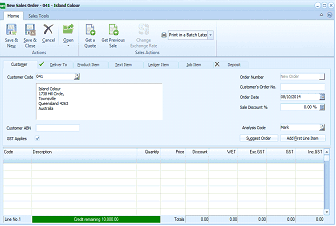 Image Description
The New Sales Order screen for customer 041 - Island Colour. The toolbar shows buttons for Save & New, Save & Close, Cancel, Open, Get a Quote, Get Previous Quotes, Change, and Print in a Batch Later under Sales Actions. Tabs include Customer, Deliver To, Product Item, Text Item, Ledger Item, Job Item, and Deposit. The Customer tab is active showing fields for Customer Code (041), customer address (Island Colour, 172 Mill Drive, Toowoomba, Queensland 4263, Australia), Customer ABN, GST Applies checkbox, Order Number (New Order), Customer's Order No, Order Date (09/10/2014), Sale Discount % (0.00%), Average Days for delivery, and a "Suggest Order" button. An "Add First Line Item" button is visible. The product grid at the bottom shows columns for Code, Description, Quantity, Price, Discount, WET, Ex.GST, Est GST, and Est $T. Credit remaining of 10,000.00 is shown.
New Sales Orders
The Order Menu contains the following options:
-
Order Header
-
Deliver To
-
Product Item
-
Text Item
-
Ledger Item
-
Job Item
**Order Header ** The first part of ordering products is to enter the basic details of the order into the 'Order Header' fields. These fields are:
-
Customer Code: Enter the unique identifying code for the customer here. Alternatively, press F3 or click the button to the right of the field to select from the customer list. To create a new customer account, see Setting up Customer Accounts.
-
Customer Details: Enter the name and address of the customer here, as entered in the set up phase. Customer details appear here when you enter the customer code in the previous field.
-
Customer ABN: Enter the customer's Tax registration number here.
-
GST/VAT Applies: By default, this box is checked, indicating that the order is subject to Tax . If this is not the case, uncheck the box.
-
Analysis Code: The name of the appropriate contact for this item appears here. It can be changed by entering a new one or by pressing F3 or by clicking the button to select from the list.
-
Order Number: If you are editing or deleting an existing order, the order number appears here. Otherwise, it will remain greyed out saying: 'New Order'
-
Customer's Order Number: Enter the customer's order number here, if they provide one.
-
Order Date: Enter the date on which the order is made. This field is set to today's date by default. Press F3 or click the button to the right of the field to check the calendar.
-
Sale Discount %: Enter the default discount that applies to the whole sale, on top of any line item special price. By default, this field is set to 0.00%.
-
Suggest Order: Select this option to view a record of the past 50 products the customer bought from you and at what price. This will help you suggest to the customer what products to order. Enter the product quantity in the 'Quantity this Order' field and click 'OK' to close the screen and place the product in order screen. You can select 'View Product Details' to see the product price structure and if it is in stock.
-
Add First Line Item: Once all the details have been entered in the above fields, select this option to include product details in the quote. This will display the 'Product Item' section:
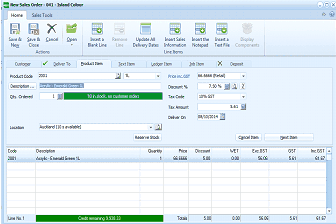 Image Description
The New Sales Order screen showing the Product Item tab for customer 041 - Island Colour. The Sales Tools toolbar is visible with additional buttons including Insert a Blank Line, Remove Line, Update All Delivery Dates, Insert Sales Information, Insert the Notepad, Insert a Text File, and Display Components. The Product Item tab shows fields for Product Code (2001), Description (showing "10 x 200L as customer order"), Quantity, Discount %, Tax Code (10% GST), Tax Amount, and a delivery date (09/10/2014). Location shows "Auckland (11 in stock)". The product grid at the bottom shows an entry for product 2001 "Acrylic - Forest Green 1L" with quantity, price, discount, WET, and GST values. A "Cancel Item" and "Next Item" button are visible. Credit remaining of 3,820.13 is shown.
Product Item section of New Sales Orders
As you enter the product details, they appear in the grid in the lower half of the screen. The totals also appear, so the user can see at a glance the running totals for the order.
**Product Item **
-
Product Code: Enter the code of this product for this sale. Press F3 or click the button to the right of the field to select from the list. If you know the barcode, enter the barcode and it will automatically be recognised. By default the quantity is set to first unit of measure in the field to the right. You can select a different unit of measure if more than one unit of measure has been set up for that product. See Setting up Product Accounts to set up a new unit of measure for the product.
-
Description: Once the product code or barcode is entered, the description of the product, as entered in the set up phase appears.
-
Qty. Ordered: enter the quantity ordered at this time, including any back order. Press F3 or click the calculator button to the right of the field to enter the quantity amount.
-
Location: Select the location for this order from the drop down list or press F3 or click the button to select from the list. When you select the location from the drop down list it will display the quantity on hand for that location. To set up a location for your product see Setting up a Stock Location.
-
Unit Cost Amount: Enter the cost price of the product per unit. Press F3 or click the calculator button to the right of the field to enter the amount.
-
Delivery: Enter the date on which the order is made. By default this field is set to today's date. Alternatively, press F3 or click the calendar button.
-
Price ex. GST/VAT%: Select the price of the product excluding Tax from the drop-down list. If a customer is in a Trade group (see Setting up Customer Groups) the Trade price for that product will automatically appear. To set different product prices for different groups of customers, e.g. Retail, Wholesale, and so on, see Setting up Product Accounts. To view the cost of the product and the margin on this transaction, click the % button.
-
Discount %: Enter the discount rate that applies to this line item, if any. The default discount rate is set at 0.00%.
-
GST/VAT Code: By default, this box is set at 10% GST/VAT, indicating that the order is subject to Tax of 10%. If this is not the case, select and alternative entry from the drop-down list. To set up a new Tax category, see Setting up a Tax Category.
-
GST/VAT Amount: Enter the Tax amount if different from the calculated figure. Press F3 or click the calculator button to the right of the field to enter the amount.
-
Cancel Item: Warning: Selecting this option cancels the entries made on this section.
-
Next Item: Once all the details have been entered, select this option to add another product description to the grid for this order. Note the details appear in the table to the bottom of the screen.
Text Item
-
Block of Text: You can enter unlimited text to describe a product in more detail. After you have entered your text, click 'Next Item' and the text automatically appears in the 'Description' field of the grid.
Note the details appear in the table to the bottom of the screen.
**Ledger Item ** The Ledger Item section is for entering expenses and services other than product costs, such as postage, shipping and so on.
-
Account Code: Enter the appropriate ledger account code here. Press F3 or click the button to select an account code from the ledger list. See Adding a Ledger Account for details on how to set up a ledger account.
-
Description: The description entered here appears on the printed document and on the ledger account history.
-
Qty. Ordered: Enter the total quantity of this item ordered at this time. Press F3 or click the calculator button to enter the quantity amount.
-
Location: Enter the start of the location name for this order or press F3 or click the button to select from the list.
-
Unit Cost Amount: Enter the cost price of the expense/service per unit. Press F3 or click the calculator button to the right of the field to enter the amount.
-
Delivery: Enter the anticipated delivery date here. By default, this is set to today's date. Press F3 or click the calendar button to select an alternative date.
-
Price ex. GST/VAT: Enter the price, excluding Tax here. The price can be changed by entering a new one or by pressing F3 or by clicking the button to select from the list.
-
Discount %: Enter the discount rate that applies to this line item, if any. The default discount rate is set at 0.00%.
-
GST/VAT Code: By default, this box is set at 10% GST, indicating that the order is subject to Tax of 10%. If this is not the case, select an alternative entry from the drop-down list. To set up a new Tax category, see Setting up a Tax Category.
-
GST/VAT Amount: Enter the Tax amount if different from the calculated figure. Press F3 or click the calculator button to the right of the field to enter the amount.
-
Cancel Item: Warning: Selecting this option cancels the entries made on this section.
-
Next Item: Once all the details have been entered, select this option to add another item to the text line for this order. Once all the items are entered move to the next section. Note the details appear in the table to the bottom of the screen.
**Job Item ** The Job Item section is provided so you can generate an order based on a job you are carrying out for a customer.
-
Job Code: Enter the code of the job for this sale. Press F3 or click the button to select from the list. To set up a job record, which includes a job code, see Adding Jobs.
-
Description: Once the job code is entered, the description of the job, as entered in the set up phase appears.
-
Qty. Ordered: Enter the quantity ordered at this time. Press F3 or click the calculator button to enter the quantity amount.
-
Charge ex. GST/VAT: Enter the charge, excluding GST/VAT here. The charge can be changed by entering a new one or by pressing F3 or by clicking the calculator button.
-
GST/VAT Code: By default, this box is set at 10% GST/VAT, indicating that the order is subject to Tax of 10%. If this is not the case, select an alternative entry from the drop-down list. To set up a new Tax category, see Setting up a Tax Category.
-
GST/VAT Amount: Enter the Tax amount if different from the calculated figure. Press F3 or click the calculator button to the right of the field to enter the amount.
-
Cancel Item: Warning: Selecting this option cancels the entries made on this section.
-
Next Item: Once all the details have been entered, select this option to add another item to the text line for this order.
Note the details appear in the table to the bottom of the screen.
Deposit Use this section if the customer wants to place a deposit on the order. The payment will create a new outstanding item which will need to be offset against the invoice when the balance is paid. You can view a record of the deposit in the Transactions section of the customer account.
-
Credit Account: Select the account to which the deposit is to be paid from the drop-down list.
-
Deposit Number: Enter a reference number that will be used to group receipts on the deposit list.
-
Amount Paid: Enter the actual amount paid by the customer.
-
Paid By: Enter the method of payment here by selecting either Transfer, Cheque, Credit Card, or Cash. If payment is by transfer, a reference number must be entered; if payment is by cheque, a cheque number must be entered; if payment is by credit card, the card and authorisation details must be entered; and if payment is by cash, a receipt number must be entered. These fields automatically appear after you have selected the method of payment.
-
Confirm Payment: Click here to confirm that the amount shown above has been paid in relation to this order.
Deliver To:
You can select the delivery address by selecting the Deliver To tab and selecting the delivery address from the drop down list. Alternatively you can select to deliver to another customer by entering that customer's code or selecting F3 to get a list of customers.
Save Settings When you have entered the relevant order details, select either: Save and Close: This will save the order information and bring you back to the main menu. or: Save and New: This will save the order information and open a new 'New Sales Orders' screen.