Timesheets
Timesheets
Timesheets involve taking a particular staff member, and allocating their times against different jobs.
To enter a Timesheet:
-
Select Jobs (left of main screen) and a list of existing jobs (if any) appears as below:
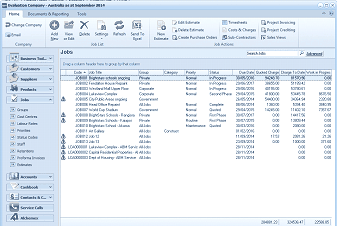
The ABM main application window is shown displaying the "Jobs" list view. The title bar shows "Evaluation Company - Australia as at September 2011". The left side shows a folder navigation tree. The main viewing area on the right displays a "Jobs" list with a search bar and "Advanced" link. The list shows multiple job records in a data grid with columns for Code, Job Title, Group, Category, Status, Quoted, Charges, and other financial columns. Visible job entries include various jobs with their groups, statuses, and financial values. A toolbar at the top includes buttons for Edit Estimate, Timesheets, Costs & Charges, Create Purchase Orders, Sub-Contractors, and Project Invoicing. The bottom shows totals.
List of existing Job records (if any)
Note: It is possible to sort all job records in ascending or descending order under titles such as Code, Job Title, Group, Category, by clicking the relevant heading (on top of main viewing area). Once clicked you will see an arrow beside the heading, if the arrow is pointing upwards, then this will sort in ascending order. If the arrow is pointing downwards, then this will sort in descending order. Simply select the heading to toggle between the two if required.
-
Select the job record to which you want to add a timesheet, so that the record is highlighted.
-
In the Job Transactions menu bar, select Timesheets and a Timesheet Entry screen appears as below:
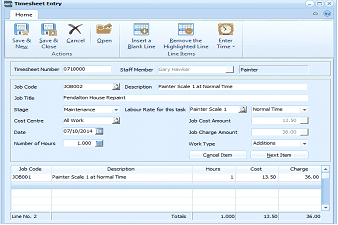
The "Timesheet Entry" dialog window is displayed for entering timesheet data against a job. The toolbar at the top has a Home tab with buttons for Save & New, Save & Close, Cancel, Open, "Insert a Blank Line", "Remove the Highlighted Line", and "Enter Time" under respective groups. The main form shows fields for Timesheet Number (showing "0710000"), Staff Member (showing "Gary Muncher" with job title "Painter"), Job Code (showing "JOB002" with description "Painter Scale 1 at Normal Time"), Job Title ("Fendelton House Request"), Stage ("Maintenance"), Labour Rate for this task (showing "Painter Scale 1"), Cost Centre ("All Work"), Date (07/10/2014), Number of Hours (1.000), Job Cost Amount field, Job Charge Amount field, Work Type (set to "Normal"), and an "Additions" field. Below is a data grid showing entered timesheet items with columns for Job Code, Description, quantity, Cost, and Charge. A visible entry shows "JOB001 Painter Scale 1 at Normal Time" with cost of 13.50 and charge of 36.00. Buttons for "Cancel Item" and "Next Item" are available. The bottom shows line totals.
New Timesheet Entry
-
Timesheet Number: Enter the unique identifying reference for this timesheet so you can recognise the entry in reports later. The reference can be either in numbers and/or characters.
-
Staff Member: Select the staff member that carries out the labour by entering their name. Alternatively, press F3 or select the button to the right of the field to select from a list of existing staff member. After you have entered the staff name, their job title appears to the right of the field. To record a new staff member, see Adding Staff Members.
-
Job Code: Enter the code of the job for this timesheet. Press F3 or click the button to select from the list. After you have entered the job code, the job title appears to the right of the field. To set up a job record, which includes a job code, see Adding Jobs.
-
Stage: Select from the drop-down list the stage (if any) at which the job is.
-
Cost Centre: Enter the cost centre name here. Alternatively, press F3 or click the button to select from the list of existing cost centres. To set up a new cost centre, see Adding Cost Centres.
-
Date: Enter the date the staff member was working on the selected job. By default, this field is set to today's date. Alternatively, click the calendar option to select a date.
-
Number of Hours: Enter the number of hours the selected staff member worked in decimals (E.g., Four hours 30 minutes will be 4.5 hours). Alternatively, press F3 or select the calculator button to calculate the number of hours worked.
-
Labour Rate for this task: Enter the labour rate for this job. Alternatively, press F3 or select the button to the right of the field to select from existing labour rates. To set up a new labour rate, see Adding Labour Rates.
-
Labour Category: Select from the drop-down list the labour category that the staff member worked in, e.g. 'Normal Time'. If the same staff member worked in two different categories, for example, 'Normal Time' and 'Time and a Half', enter the first labour category and the rates, then select 'Next Item' to enter the new labour category.
-
Job Cost Amount: After you have entered the staff member, the hours they worked and in which labour category, this field will be automatically updated.
-
Job Charge Amount: After you have entered the staff member, the hours they worked and in which labour category, this field will be updated.
-
Next Item: Once all the details have been entered, select this option to add another item to the text line in the grid. Once all the items are entered move to the next section.
Note the details appear in the grid to the bottom of the screen.
-
Cancel Item: Warning: Selecting this option cancels the entries made on this section.
Save Settings When you have entered the relevant details, select either: Save and Close: This will save the information and bring you back to the main menu. or: Save and New: This will process the information and open a new 'Timesheet Entry' screen.