Creating Email Messages
Creating Email Messages
You can add and email message to the document and this will replace the standard email message produced by ABM when e-mailing and document. To add an email message select Printer & Forms Settings and select the document you wish to add the message to and select open document . This will open the Document Maintenance screen.
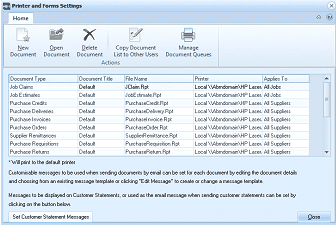
ABM Printer and Forms Settings screen. The toolbar shows buttons for New Document, Open Document, Delete Document, Copy Document List to Other Users, and Manage Document Queues. Below is a grid listing document types with columns: Document Type, Document Title, File Name, Printer, and Applies To. Documents listed include Job Claims, Job Estimates, Purchase Credits, Purchase Deliveries, Purchase Invoices, Purchase Orders, Supplier Remittances, Purchase Requisitions, and Purchase Returns, each showing default settings with form file names and printer assignments. A note at the bottom states "* Will print to the default printer" and provides options for customizable messages and a "Set Customer Statement Messages" button with a Close button.
Printer & Forms Settings screen.
When the document maintenance screen is opened select New Message. When you save the document message it will be available from the drop down list for selection on further documents.
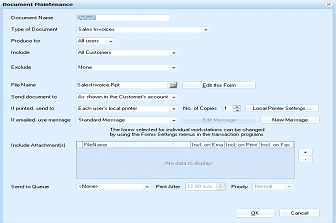
ABM Document Maintenance dialog box showing a document configured for Sales Invoices. Fields visible include: Document Name, Type of Document (Sales Invoices), Produce For (All users), Include (All Customers), Exclude (None), File Name (SalesInvoice.Rpt with "Edit this Form" button), Send document to (As shown in the Customer's account), If printed send to (Each user's local printer, No. of Copies: 1, Local Printer Settings button), and If emailed use message (Standard Message with "Edit Message" and "New Message" buttons). A notice at the bottom explains that forms for individual workstations can be changed via Forms Settings in the transaction programs. The Include Attachments section and Send to Queue options are also visible with OK and Cancel buttons.
When you select New Message a screen will appear allowing you to build your email message.
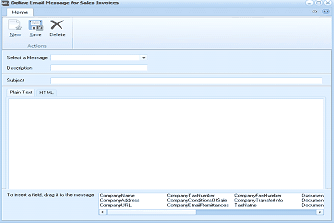
ABM "Define Email Message for Sales Invoices" dialog window. The toolbar shows Home tab with buttons for New, Save, and Delete under Actions. Below are fields: Select a Message (dropdown), Description (text field), and Subject (text field). A toggle for "Plain Text" or "HTML" format is shown. The main area is a large blank text editing region for composing the email message body. At the bottom is a section labeled "To insert a field, drag it to the message" with available database field tags including CompanyName, CompanyAddress, CompanyRegistration, CompanyVATNo, CompanyPSTNo, CompanyTradeName, and others that can be dragged into the message.
New Message: To create a new message select New and enter a description for that message. You can then design you email message.
From Address: If you wish to have a universal email address for you company you can enter the from address. This will override the sending email account in Outlook. Example Sales@EvalCo.Com
Reply Address: If you wish to enter a different email address so that the recipient can reply to an alternative address enter that address here. Example accounts@EvalCo.Com
Email Message: You can create the message to appear as Plain Text or HTML format. Once you have decided on the format you can type in any message you require. You can add fields from the database such as customer name by dragging these fields onto the main body of the form. TIP: If you drag in the customer name and then wish to add the address on the next line then select the enter key to move to the next line before dragging the next field.
Save: When you have completed the message select save and this will save the document. Select Close to close the message edit screen.
Edit Message: If you wish to edit an email message select that message from the drop down list and then make the required changes or select Delete if you no longer require this message.