Maintaining Exchange Rates
Maintaining Exchange Rates
If you intend trading with overseas customers, you will need to maintain exchange rates on a regular basis. This might be done at the start of the day's processing or at whatever interval you prefer. It is a good idea to get into the habit of doing this first thing in the morning, every morning, as this will eliminate the danger of forgetting some currencies.
Once the exchange rate is changed, ABM will scan all outstanding invoices and credits and calculate gains and losses where applicable. The Nominal Ledger variation and Balance Sheet Accounts are then updated automatically.
To change/update Exchange Rates:
-
Select Accounts in the Folders list.
-
In the list of sub-categories, select Currencies.
-
On the menu bar, select Update Exchange Rates, and a Foreign Currencies Exchange Rates screen appears as below:
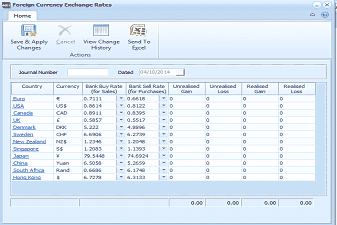
The "Foreign Currency Exchange Rates" screen showing a toolbar at the top with buttons: "Save & Apply Changes", "Cancel", "View Change History", and "Send To Excel". Below is a "Journal Number" field and a "Dated" field showing a date. The main area contains a table listing foreign currencies with columns: Country, Currency, Bank Buy Rate (for Sales), Bank Sell Rate (for Purchases), Unrealised, Unrealised, Realised, and Realised Gain/Loss. Rows include currencies such as USA (US$), UK (GBP), Canada (CA$), Euro, Sweden (SKR), Denmark (DKK), Singapore (S$), New Zealand (NZ$), Hong Kong (HK$), Japan (Yen), Egypt, South Africa (Rand), and Papua New Guinea, each showing their respective buy and sell exchange rates.
Foreign Currency Exchange Rates
-
Journal Number: Enter a reference number that will be used to identify this journal in reports later. On the top right hand side of the screen the following fields appear:
-
Bank Buy Rate (for sales): Enter the bank's buying rate here. This is normally for supplier transactions where you are buying base currency
-
Bank Sell Rate (for purchases): Enter the bank's selling rate here. This is normally for customer transactions where you are selling base currency.
-
View Change History: You can view the previous exchange rate changes by selecting a currency and selecting View Change History.
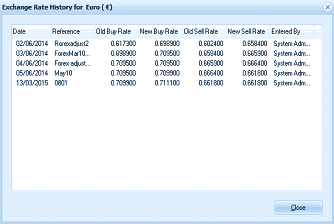
The "Exchange Rate History for Euro" dialog box showing a table with columns: Date, Reference, Old Buy Rate, New Buy Rate, Old Sell Rate, New Sell Rate, and Entered By. The table displays several rows of historical exchange rate changes with dates, reference numbers, and the corresponding old and new buy/sell rates, along with the user (System Administrator) who made each change. A "Close" button is located at the bottom right of the dialog.
Save and Apply Changes: Computes and posts the unrealised gains or losses to the Accounts.